Showing posts with label Barcelona. Show all posts

Thursday's Child: Park Guell

Thursday, March 1, 2012


Any time we visit a new city, we try to check out at least one of its parks.  Urban parks are often what make a city livable, and ideally should accommodate both tourists and locals.  This month, I’ll write about some of the loveliest parks we’ve had the pleasure to visit.

One of the most enchanting ones was Park Guell in Barcelona, designed by Antoni Gaudi.  If you’ve been reading my blog for a while, you’ll know how I love Gaudi’s work (I’ve written about La Pedrera  and Sagrada Familla, to name just two).  His park, although quite different from those buildings, was as stunning as anything else he’s designed.


This project reflected Gaudi’s love of nature.  He incorporated natural designs throughout the park, from seashell motifs to the colourful dragon fountain at the entrance.


One of the strongest characteristics of the park is the amazing tile work throughout.  Gaudi used cast-off ceramic pieces to create unimaginably beautiful mosaics on everything from the underside of the viaduct to that iconic dragon fountain.  In the central core, tiles decorate the benches that wind, snake-like, through the area.
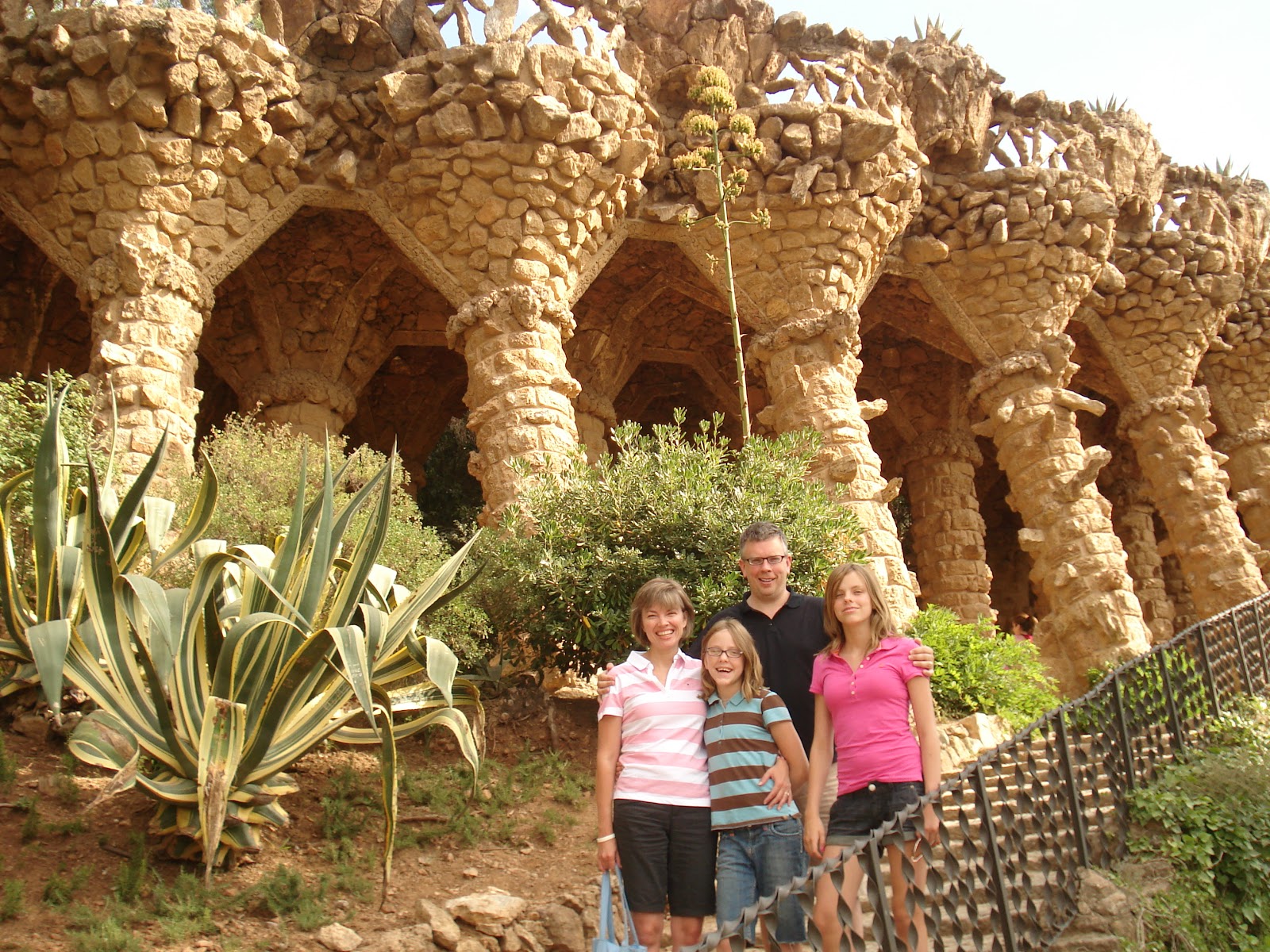

A footpath under the viaduct is lined with columns designed to look like trees, another way in which Gaudi made the architectural structures in the park mirror the nature around it.  But these columns often contained fanciful designs, as in the photo below:


We loved Park Guell so much that we returned on our last day in Barcelona to see it one more time.  To me, it represents everything that’s great about a city park – it’s unique, and both approachable and challenging.  And it feels like it belongs exactly where it’s built.

Thursday's Child: Sagrada Familia

Thursday, January 12, 2012
One of the most unique places of worship we’ve visited is Barcelona’s Sagrada Familia. 130 years after it was first commissioned, it’s still under construction, and years away from being done. 

This basilica, known in English as the Church of the Holy Family, was begun in 1882, with the idea that it would be finished in a decade.  However, a year later, the great architect Antoni Gaudi took over the project, and the scope of the building as well as the timelines of the project were radically changed. 

I’ve written about Gaudi before (here and here); in this project, as well as others, his originality and vision are breathtaking.  He often changed his plans partway through a project, which was one of the reasons for the delays in finishing.  Once, when asked why it was taking so long to complete the basilica, he answered, “My client is not in a hurry.”

When Gaudi died in 1926, the building was only 25% finished.  For a while, the project slowed down or stopped completely, due to both the Spanish Civil War and the drying up of private donations.  It was assumed that the Barcelona skyline would forever be dominated by this half-finished place of worship.

However, the Barcelona Olympics and the entry of Spain into the European Union renewed interest in this glorious city and its unusual basilica.  Now, construction is being funded by entrance fees, and completion is once again possible.  Some critics say it could be finished in 2026, the hundredth anniversary of Gaudi’s death. Other estimates say it’s as far off as eighty years in the future.

As in his other buildings, Gaudi shunned flat surfaces and straight lines, using curves, circles and elaborations nearly everywhere, inside and out.  Sculptures range from the crude and primitive to extravagant and ornate.   Columns twist and turn, and change shape completely as they rise.

Opinions about the basilica have been mixed, to say the least.  When dedicating it in November 2010, Pope  Benedict described it “as a hymn of praise to God carved in stone”.   On the other hand, George Orwell once called it “one of the most hideous buildings in the world”.  Whatever you think of it, Sagrada Familia truly is a one-of-a kind church.


Thursday's Child: Casa Batllo, Barcelona

Thursday, June 16, 2011


Casa Batllo was another of Antoni Gaudi’s private commissions in Barcelona.  Like La Pedrera, it was built on Barcelona’s iconic street, Passeig de Gracia, and avoids any use of straight lines.  Irregular windows and balconies, and the extensive use of glass and the colour blue in the interior, lend it a beguiling appearance. 


Casa Batllo, both stately and enchanting, feels like it was lifted from a modernist fairy tale and set down in the middle of Barcelona.  As we explored the silent rooms we could have been stepping into the long-dormant castle of Sleeping Beauty.  The lovely princess, cursed to sleep for one hundred years, must have been as captivated by its artistry as the prince who came to rescue her.


Shielded for one hundred years, the enchanted castle looms.


A rooftop beacon to Prince Charming.


Flowers set in stone could only be the hallmark of a castle cursed by an evil fairy.


The inner courtyard, illuminated by sunlight.


Thursday's Child: La Pedrera, Barcelona

Thursday, June 9, 2011

Last week, I mentioned that this month I was writing about great architecture we’ve seen.  But after thinking about some of the amazing buildings we’ve been fortunate to visit, I realized I had enough in Spain to do a month’s worth. 
La Pedrera, photo courtesy of nextours.
Casa Mila was built in Barcelona in the early twentieth century by the incomparable architect, Antoni Gaudi.  Commissioned by the Mila family, it’s more commonly known as La Pedrera (The Quarry). Unsurprisingly, when it was built it was the object of criticism from those who felt its unorthodox exterior resembled a stone wall pitted with caves.  The building seems to undulate, thanks to the wave-like balconies with their delicate wrought-iron railings.

The interior of the house is astonishing.  Rooms are asymmetrical, and Gaudi completely avoided using straight lines within.  One tenant unhappily told him that not one of the irregularly shaped walls was a suitable place to put her piano.  Apparently, Gaudi suggested she take up the violin.

But it’s the roof that is really the star.  Most architects, faced with the task of installing chimneys and ventilators, would try to hide them, or at least minimize their appearance.  Not Gaudi, who turned them into fabulous sculptures. 

These tall, conical structures tower over their observers and look like alternate inukshuks.  Could they be landmarks left behind by space travelers from an ancient time?  It isn’t a stretch to believe they were left there one night by a tribe that vanished as quickly as they’d arrived.    
Next week I'll be writing about another of Gaudi's brilliant buildings!