One of the most incredible feats of art or architecture I've seen are the Terracotta warriors of Xian, China. Built in about 200 B.C, they were buried and hidden from the world until 1974, when local farmers digging a well accidentally unearthed them.
This collection of life-sized warriors and horses made of terracotta were commissioned by the first emperor of China, Qin Shi Huang. Designed to represent his imperial guard, they were built in pieces and then assembled before being fired. Many of them are believed to have been built holding actual weapons, although those have since either rotted or been stolen.
Although excavation still continues, it's estimated that there are 8,000 soldiers, 130 carriages and 600 horses. Historical records show that over 700,000 workers were involved in building this army. And the terracotta pieces probably owe their survival to the fact that the emperor insisted they be buried with him when he died.
The history behind these magnificent warriors is fascinating, but the most amazing moment was that breathtaking second when we walked into the chamber and were faced with lines of soldiers that seemingly went on forever. They were an incredible testament to the creativity and vision of a long-gone empire.
Hope is the thing with feathers
Sunday, February 17, 2013
"Hope is the thing with feathers -
That perches in the soul -
And sings the tune without the words -
And never stops - at all -
And sweetest - in the Gale - is heard -
And sore must be the storm -
That could abash the little Bird
That kept so many warm -
I've heard it in the chillest land -
And on the strangest Sea -
Yet - never - in Extremity,
It asked a crumb - of me."
- Emily Dickinson, "Hope is the Thing with Feathers"
Why does so much great poetry come from humble images? Bread is one of the earliest and simplest forms of nutrition, but it's the basis of many poems, including this one by Emily Dickinson ("asked a crumb of me"). Dickinson was actually an accomplished baker, and her loaves of bread once placed second in a local baking contest (although it must be noted that her sister was one of the judges). She took on the daily task of baking bread for the family when their housekeeper quit, and kept it up after they hired a new housekeeper because her father preferred her bread. And although she rarely left her home in Amherst, Massachusetts, she often sent baking to the homes of the bereaved and ill.
Upon further reflection, baking is a natural subject for literature. As a writer, I often find myself baking, whether it's bread or something sweet. There's something about the process of stirring, mixing and blending that sets my mind free and lets it wander around whatever manuscript I'm working on at the moment. (And how is my writing going right now? Pretty slowly, but "hope is the thing with feathers...")
Information on Emily Dickinson provided by PBS.
Easy Oat Bread
(from Kneadlessly Simple, by Nancy Baggett)
5 1/2 cups unbleached white bread flour or all-purpose white flour
1 cup old-fashioned rolled oats or quick-cooking (not instant) oats, plus 4 Tbsp for garnish
3 Tbsp granulated sugar
Scant 2 3/4 tsp kosher salt
1 tsp instant, fast-rising, or bread machine yeast
1/4 cup clover honey
1/4 cup corn oil or canola oil, plus extra for coating dough top and baking pans
2 1/4 cups plus 2 Tbsp ice water, plus more if needed
First rise: In a very large bowl, thoroughly stir together the flour, oats, sugar, salt and yeast. In a medium bowl or measuring cup, thoroughly whisk the honey and oil into the water. Stir the water mixture into the larger bowl, scraping down the sides until the ingredients are thoroughly blended. Brush the top with oil and cover the bowl with plastic wrap. Let rise at cool room temperature for 12 to 18 hours; if convenient, vigorously stir once during the rise.
Second rise: Vigorously stir the dough. Generously oil two 9" x 5" loaf pans. Sprinkle a tablespoon of oats in each; tip the pans back and forth to spread the oats over the bottom and sides. Use well-oiled kitchen shears or a serrated knife to cut the dough into two equal portions. Put the portions in the pans and brush the tops with oil. Press and smooth the dough evenly into the pans. Spread a tablespoon of oats over each loaf and press down to embed. Make a 1/2 inch deep slash lengthwise down the centre of each loaf. Tightly cover the pans with plastic wrap.
Let rise: For a 2- to 3-hour regular rise, let stand at warm room temperature. (Alternatively, for a 45 minute to 2-hour accelerated rise, let stand in a turned-off microwave along with 1 cup of boiling-hot water.) Continue the rise until the dough nears the plastic, then remove it and continue until the dough extends 1/2 inch above the pan rims.
Baking: 15 minutes before baking time, preheat the oven to 375 degrees. Bake for 50 to 60 minutes, until the tops are well-browned. Cover the tops with foil. Then bake for 10 to 15 minutes more, until a skewer inserted in the thickest part comes out with just a few particles clinging to the bottom. Bake for 5 minutes longer to be sure the centres are done. Let cool in the pans on a wire rack for 15 minutes. Turn out the loaves onto racks and cool thoroughly.
That perches in the soul -
And sings the tune without the words -
And never stops - at all -
And sweetest - in the Gale - is heard -
And sore must be the storm -
That could abash the little Bird
That kept so many warm -
I've heard it in the chillest land -
And on the strangest Sea -
Yet - never - in Extremity,
It asked a crumb - of me."
- Emily Dickinson, "Hope is the Thing with Feathers"
Why does so much great poetry come from humble images? Bread is one of the earliest and simplest forms of nutrition, but it's the basis of many poems, including this one by Emily Dickinson ("asked a crumb of me"). Dickinson was actually an accomplished baker, and her loaves of bread once placed second in a local baking contest (although it must be noted that her sister was one of the judges). She took on the daily task of baking bread for the family when their housekeeper quit, and kept it up after they hired a new housekeeper because her father preferred her bread. And although she rarely left her home in Amherst, Massachusetts, she often sent baking to the homes of the bereaved and ill.
Upon further reflection, baking is a natural subject for literature. As a writer, I often find myself baking, whether it's bread or something sweet. There's something about the process of stirring, mixing and blending that sets my mind free and lets it wander around whatever manuscript I'm working on at the moment. (And how is my writing going right now? Pretty slowly, but "hope is the thing with feathers...")
Easy Oat Bread
(from Kneadlessly Simple, by Nancy Baggett)
5 1/2 cups unbleached white bread flour or all-purpose white flour
1 cup old-fashioned rolled oats or quick-cooking (not instant) oats, plus 4 Tbsp for garnish
3 Tbsp granulated sugar
Scant 2 3/4 tsp kosher salt
1 tsp instant, fast-rising, or bread machine yeast
1/4 cup clover honey
1/4 cup corn oil or canola oil, plus extra for coating dough top and baking pans
2 1/4 cups plus 2 Tbsp ice water, plus more if needed
First rise: In a very large bowl, thoroughly stir together the flour, oats, sugar, salt and yeast. In a medium bowl or measuring cup, thoroughly whisk the honey and oil into the water. Stir the water mixture into the larger bowl, scraping down the sides until the ingredients are thoroughly blended. Brush the top with oil and cover the bowl with plastic wrap. Let rise at cool room temperature for 12 to 18 hours; if convenient, vigorously stir once during the rise.
Second rise: Vigorously stir the dough. Generously oil two 9" x 5" loaf pans. Sprinkle a tablespoon of oats in each; tip the pans back and forth to spread the oats over the bottom and sides. Use well-oiled kitchen shears or a serrated knife to cut the dough into two equal portions. Put the portions in the pans and brush the tops with oil. Press and smooth the dough evenly into the pans. Spread a tablespoon of oats over each loaf and press down to embed. Make a 1/2 inch deep slash lengthwise down the centre of each loaf. Tightly cover the pans with plastic wrap.
Let rise: For a 2- to 3-hour regular rise, let stand at warm room temperature. (Alternatively, for a 45 minute to 2-hour accelerated rise, let stand in a turned-off microwave along with 1 cup of boiling-hot water.) Continue the rise until the dough nears the plastic, then remove it and continue until the dough extends 1/2 inch above the pan rims.
Baking: 15 minutes before baking time, preheat the oven to 375 degrees. Bake for 50 to 60 minutes, until the tops are well-browned. Cover the tops with foil. Then bake for 10 to 15 minutes more, until a skewer inserted in the thickest part comes out with just a few particles clinging to the bottom. Bake for 5 minutes longer to be sure the centres are done. Let cool in the pans on a wire rack for 15 minutes. Turn out the loaves onto racks and cool thoroughly.
Thursday's Child: The Roman Forum
Thursday, February 14, 2013
| Temple of Saturn |
For several centuries, the Roman Forum was the focal point of public life. Temples, government buildings, a marketplace and courts of law were among the important structures erected here. Military parades usually wound around Palatine Hill and concluded in the Forum. When Marc Antony spoke after Julius Caesar's funeral to rouse the citizens, it was in the Forum.
The arch of Septimius Severus, shown above, was built to commemorate that emperor's victory against the Parthian Empire (part of ancient Persia) in the early third century. The panels on the arch provide a pictorial description of those wars.
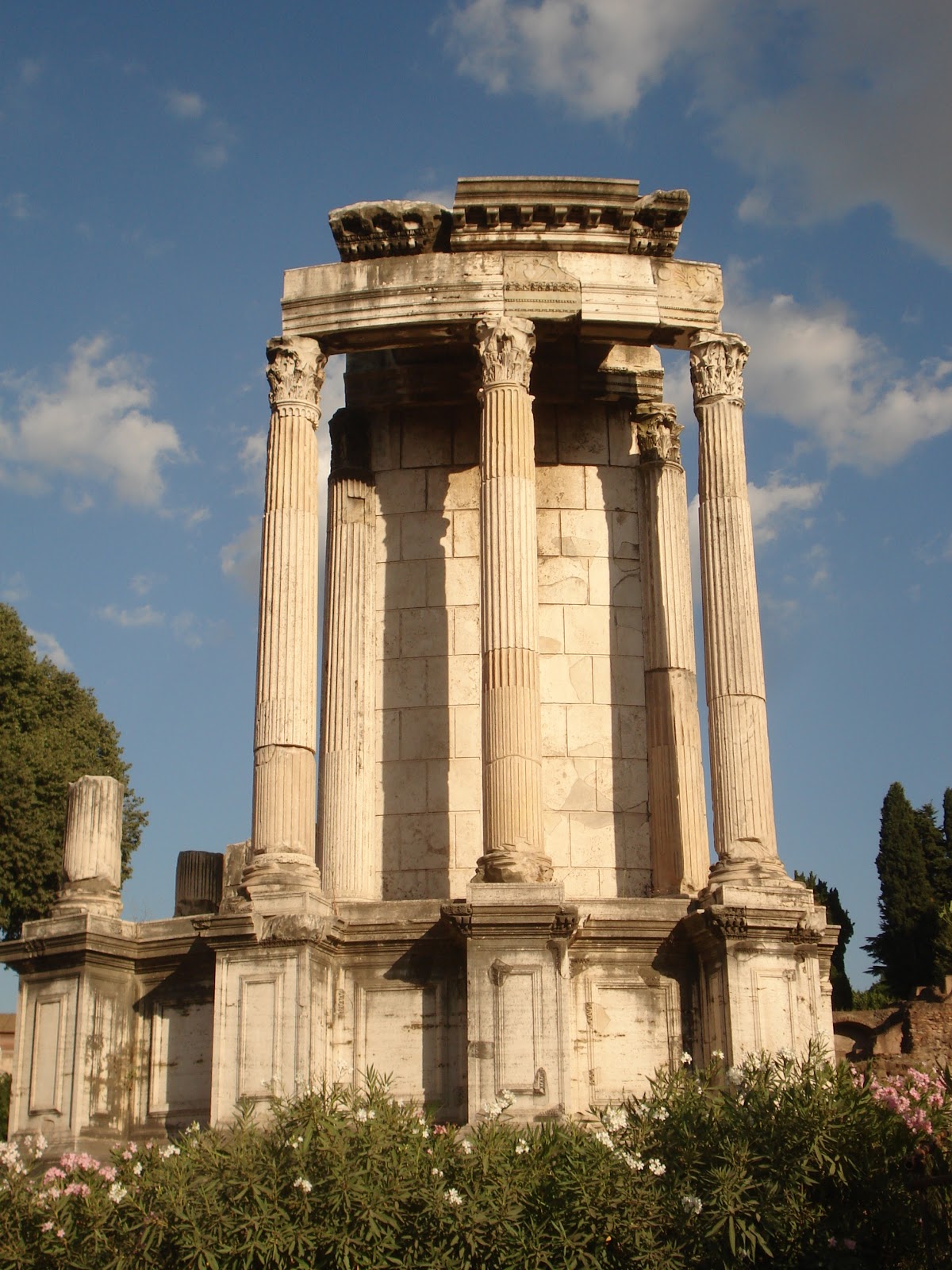
The Temple of Vesta, above, was one of the earliest structures built in the Forum, although it was subsequently rebuilt twice. It was devoted to Vesta, the goddess of hearth and home. A sacred flame burned in the temple, and was tended by the Vestal Virgins.
| Altar of Caesar |
The Forum had very humble beginnings. Originally a swamp between kingdoms on two
hills, it was drained in the seventh century B.C. to provide a meeting place for
citizens of both areas. One of the world’s
first sewers was put in to serve it. The Forum remained influential until the sacking of Rome in 410 by the Visigoths, when
many of the buildings were destroyed. It
was covered by sediment and debris for hundreds of years, even serving as a
meadow for grazing cattle. But it was excavated in the nineteenth century, the
ruins now giving us an incredible link to those brilliant Romans and their
powerful empire.
Blueberries
Sunday, February 10, 2013
If you go to my church, you can probably see where this one's headed.
My youngest daughter sings in the youth choir, and last year I wrote about the musical they performed for our congregation. It was such a success they decided to take it on the road, so they'll be travelling to Nova Scotia in April to perform it for several congregations there.
As a result they're busy with fundraising activities, and one of those activities is selling frozen blueberries. So I felt it was my responsibility to help my readers and potential customers by posting one way you might use those berries.
I thought this coffee cake was terrific. When I first saw the recipe, I wasn't sure about the combination of blueberries and white chocolate, especially since I'm not a big fan of the latter. But I found it gently sweetens the cake, rather than overpowering it with chocolate. I liked it even better the second day when the flavours had mellowed and mingled wonderfully.
So if you go to my church, I've given you a great reason to buy blueberries from the youth choir! And if you don't, I've just given you a great new recipe.
My youngest daughter sings in the youth choir, and last year I wrote about the musical they performed for our congregation. It was such a success they decided to take it on the road, so they'll be travelling to Nova Scotia in April to perform it for several congregations there.
As a result they're busy with fundraising activities, and one of those activities is selling frozen blueberries. So I felt it was my responsibility to help my readers and potential customers by posting one way you might use those berries.
I thought this coffee cake was terrific. When I first saw the recipe, I wasn't sure about the combination of blueberries and white chocolate, especially since I'm not a big fan of the latter. But I found it gently sweetens the cake, rather than overpowering it with chocolate. I liked it even better the second day when the flavours had mellowed and mingled wonderfully.
So if you go to my church, I've given you a great reason to buy blueberries from the youth choir! And if you don't, I've just given you a great new recipe.
Blueberry and White Chocolate Coffee Cake
(from Baking Bites)
Ingredients
2 cups all-purpose flour (first amount)
1 tsp baking powder
1/2 tsp baking soda
1/4 tsp salt
1/4 cup butter, room temperature
1 cup sugar (first amount)
1 large egg
1 tsp vanilla extract
1/4 tsp almond extract
1 cup buttermilk
1 cup blueberries, fresh or frozen
1 tsp flour (second amount) – only necessary if berries are
frozen
2/3 cup white chocolate chips
1 1/2 Tbsp sugar (second amount)
Preheat oven to 350 degrees.
Line a 9” square baking pan with parchment paper.
In a medium bowl, whisk together 2 cups flour, baking
powder, baking soda and salt.
In a large bowl, cream together butter and 1 cup sugar until
light and fluffy. Beat in egg and
vanilla and almond extracts until smooth.
Stir in about half of the flour mixture, followed by the buttermilk,
and then the rest of the flour mixture.
Stir only until just combined.
If berries are frozen, toss them with 1 tsp flour to prevent
the colour from running. Fold in berries
and white chocolate chips to evenly distribute them in the batter. Pour batter into prepared pan and spread into
an even layer. Sprinkle with 1 1/2 Tbsp
sugar.
Bake for 40 – 45 minutes or until a toothpick inserted into
the centre comes out clean. Cool
completely before slicing.
Makes 16 squares.
Thursday's Child: Saadian Tombs, Marrakech
Thursday, February 7, 2013
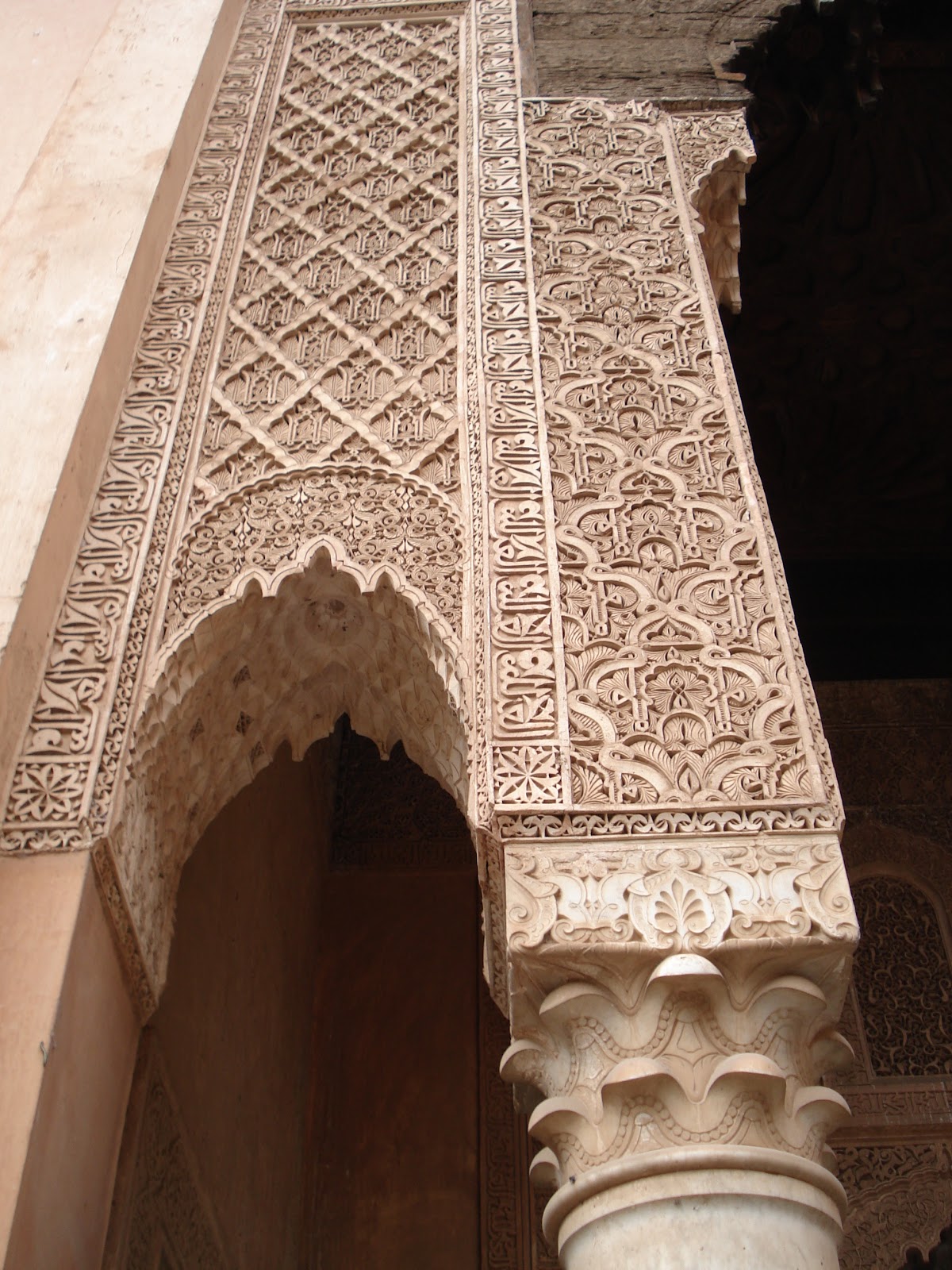
This month I'll be writing about stunning architecture, and I'll begin with the Saadian Tombs in Marrakech, Morocco.
Built in the time of Sultan Ahmad al-Mansur in the late sixteenth century, it's one of the few structures from his reign not to have been destroyed. A later sultan, Moulay Ismail, looted almost all of the buildings erected in al-Mansur's dynasty. However, he was reluctant to destroy the mausoleum because he was superstitious about grave robbery. Instead, he sealed off the complex, and it remained that way for several hundred years.
It wasn't until 1917 that an aerial map alerted a general to the tombs. They were unsealed and restored to their original beauty. And that's a high standard, considering the mausoleums were built with imported Italian Carrara marble, and the archways were lined with pure gold.
Central Mausoleum holds the spectacular Hall of the Twelve Columns, where the sultan himself and his closest family members were buried. In all, sixty members of the Saadi dynasty were buried in two main mausoleums, while another hundred were buried in the adjacent courtyard.
Burrito bowls
Monday, February 4, 2013
I don't serve a lot of beef, and I'm not sure why I don't. I grew up on a farm, and it was a staple of many of our meals. Steak has the reputation of being too expensive and it often seems too fancy for anything other than a special dinner. But in these burrito bowls, a little bit goes a long way, and you can serve it for the most casual of meals.
If I'd posted this recipe a week ago, I would have told suggested that you make it for your Superbowl party. Instead, I'll tell you to serve it whenever you want a delicious, healthy, filling meal. The abundance of kale, brown beans and red peppers make it a great nutritional choice. I'm not really a calorie-counter, but if you are, this hearty meal has less than 400 calories per serving. And no one will leave the table feeling hungry.
Steak and Brown Rice Burrito Bowl
(from Canadian Living, Feb 2013 issue)
1/4 tsp ground coriander
1/4 tsp ground cumin
1/4 tsp salt
12 ounces beef tenderloin grilling steaks (about 2)
2 tsp olive oil
1 small onion, sliced
1/2 tsp chili powder
3 cups thinly sliced stemmed kale (about half a bunch)
1 sweet red pepper, sliced
Black Beans and Rice
1 tsp olive oil
2 cloves garlic, minced
1 tsp chili powder
1 tsp ground coriander
1 tsp ground cumin
3/4 cup whole grain parboiled brown rice
3/4 cup rinsed drained canned black beans
1/2 cup bottled strained tomatoes (passata)
1/4 tsp salt
To make black beans and rice: In large saucepan, heat oil over medium-high
heat; cook garlic, chili powder, coriander and cumin, stirring, until fragrant,
about 1 minute. Stir in 1 1/4 cups
water, rice, beans, strained tomatoes, and salt. Bring to boil, cover and cook until rice is
tender, about 20 minutes. Remove from
heat. Let stand, covered, until liquid
is absorbed, about 5 minutes.
Meanwhile, stir together coriander, cumin and half of the
salt; rub all over steaks.
In a large nonstick skillet, heat half of the oil over
medium-high heat; cook steaks, turning once, until medium-rare, 7 – 8
minutes. Transfer to plate and let stand
for 5 minutes before slicing thinly.
Meanwhile, in same skillet, heat remaining oil over medium
heat; cook onion and chili powder until softened, about 3 minutes. Stir in kale, red pepper, 3 Tbsp water and
remaining salt. Cook, stirring often,
until kale is wilted and peppers are tender-crisp, about 6 minutes.
Divide rice mixture among bowls. Top with kale mixture and steak.
Thursday's Child: San Juan del Sur, Nicaragua
Thursday, January 31, 2013
This month, I've been writing about some of the wonderful beaches we've had the fortune to visit, and I'll end with one we visited last month: the beach at Morgan's Rock near San Juan del Sur, Nicaragua.
We had loved Costa Rica so much when we visited a couple of years ago that we wanted to go back to Central America. After doing some research, I kept coming back to the idea of travelling to Nicaragua. It stood out as a wonderful potential destination, with its combination of natural beauty, the lovely Spanish colonial town of Granada, and the friendly people who live there.
Nicaragua met and surpassed our expectations. If you read this blog regularly, you'll know that I love exploring the countries we visit. I'll be sure to write another day about our adventures around the country, from exploring Granada's islets by boat to hiking around the Masaya volcano, from visiting a local pottery workshop to taking in beautiful views of Apoyo Lagoon.
But today I'm writing about the beach. We took long walks in the sand and played in the water. We went kayaking in an estuary just off the beach, and we witnessed some of the most beautiful sunsets we've ever seen. We scrambled over rocks to find a hidden cave that could only be seen at low tide. We even attended the best New Year's Eve party ever on the beach, complete with an effigy that was burned to celebrate the end of the old year (a Nicaraguan custom).
Subscribe to:
Posts (Atom)