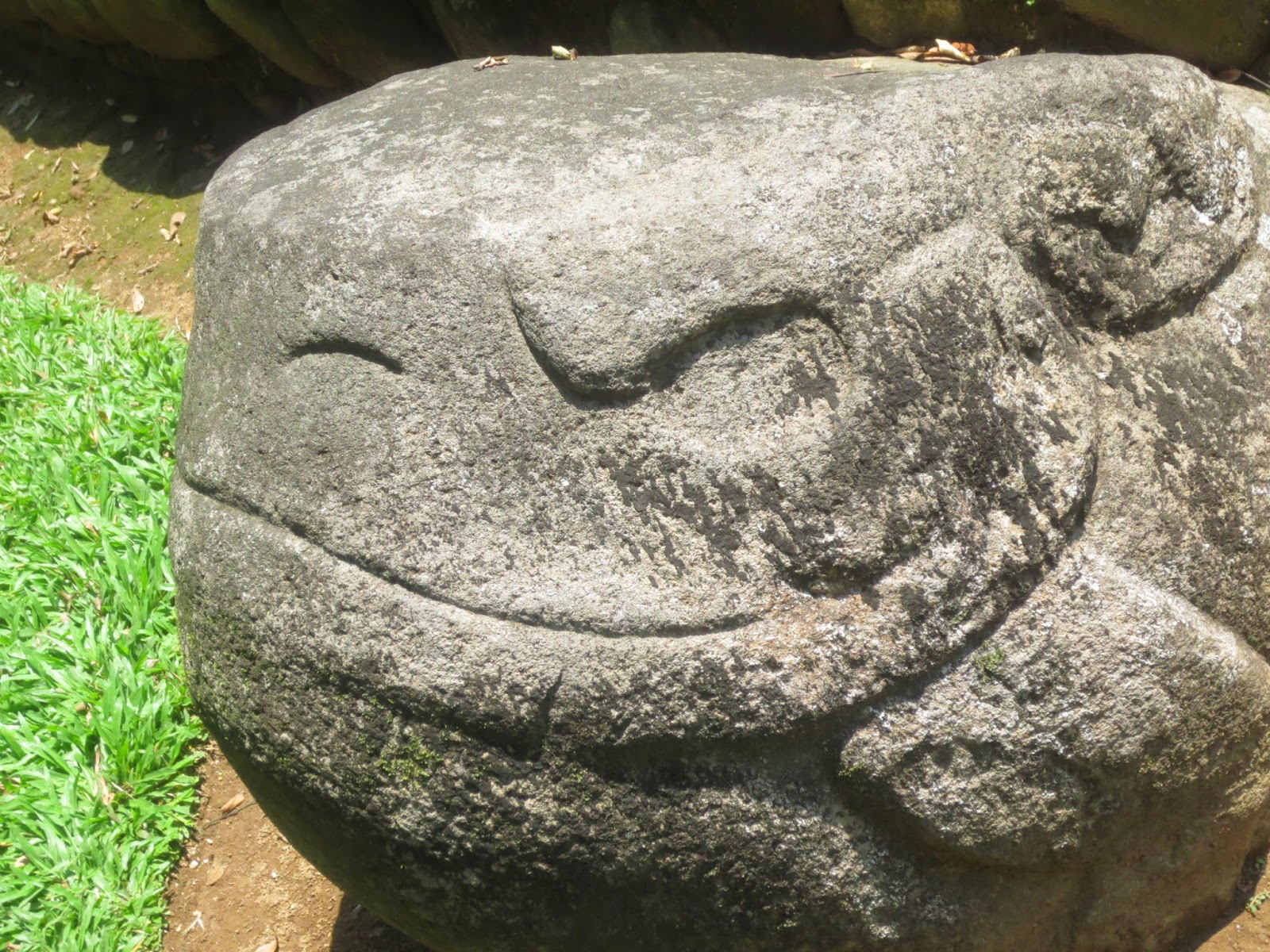
Thursday's Child: Tak'alik Ab'aj, Guatemala

Thursday, January 22, 2015
Tak’alik Ab’aj is a pre-Columbian archaeological site situated near the Pacific coast of Guatemala. In the local Kiche Maya language, it means “Place of the Standing Stone”.

Tak’alik Ab’aj was a major centre of culture and trade, first rising in power around the 9th century BCE, and lasting until 200 AD or later. It’s particularly important among Central American archeological sites because it documents the transition between the early Guatemalan Olmec people and the Mayan civilization. 


Several hundred stone monuments have been unearthed on the ten terraces that cover the 1600-acre property. Some feature the Olmec style with enormous heads and potbellied figures, or the man-jaguar. Many others feature Mayan hieroglyphics and the representation of important figures, often depicted in profile.


It’s intriguing that both styles co-exist. The Olmec style statues don’t stop suddenly and give way to a Mayan style. Nor were they destroyed when the Mayan sculptures were erected. This suggests a shifting of cultural influences and a sharing of artistic styles rather than domination due to one group conquering the other.


Tak’alik Ab’aj was part of a trading route that stretched from Mexico in the north to El Salvador in the south. It has been suggested that as traders moved from one area to another, they brought with them cultural inspirations that influenced the artwork of the settlements.

A royal tomb was discovered in 2002, perhaps belonging to the city's last Mayan king.


Excavations are still underway.

Everything Old is New Again

Sunday, January 18, 2015
We spent a couple of days with our friends, the Jay family, at their cottage over the Christmas holidays. Unlike last summer, this visit didn't involve an unusually early wake-up call. (Perhaps I was the only one nostalgic for that 5:30 am visit.) But it did involve stone soup made by nine chefs, and our annual trip to the toboggan hill near their place.

In all the years we've been friends, we've never had a photo of all nine of us. But this time, we ran into one of their neighbours while tobogganing, and he offered to take our picture. Our girls, now between 14 and 20, have grown up together despite living most of their lives in different countries. We're grateful that we see as much of them as we do.


I've written before about the traditions we share with the Jays. One more tradition is that we always bring a wedge of Chateau de Bourgogne, a triple cream Brie that, they tell us, is as good as anything they buy in Switzerland. And I always take baking, usually cookies.

I hadn't made these cookies in years. I remember taking them in when I was still working at the bank (over fifteen years ago), and being asked for the recipe. Then inexplicably, the recipe went missing. I searched through my cookbooks, I searched online. Even though I got it from Bon Appetit, it wasn't on their website. For many years, I had nothing but the memory of these cookies.

Over the holidays I found a stash of old magazines in my basement. And near the bottom of the pile was the November 1992 issue that introduced me to this recipe. It was like I was destined to bake them and bring them to the Jays'. I cut back on the butter, but otherwise didn't change this delicious recipe. Fifteen years later, the cookies were as good as I remembered. And I couldn't have been happier sharing them with our friends before they headed back to Switzerland!

Natchez Cookies
(adapted from Bon Appetit, November 1992)

Ingredients:

15 whole graham crackers (about half a package)
3/4 cup unsalted butter
1 cup packed brown sugar
1 tsp vanilla extract
1 cup chopped pecans
1 1/4 cups semi-sweet chocolate chips

Directions:

Preheat oven to 350 degrees F.

Coat a cookie sheet with parchment paper, leaving a little overlap at the sides. Arrange graham crackers on the pan side by side.

Stir butter and brown sugar together in a saucepan over medium heat until butter melts and sugar dissolves. Mix in vanilla extract; increase heat and boil for 1 minute. Pour caramel mixture over the graham crackers. Sprinkle pecans on top.

Bake until topping is bubbling and turns deep brown, about 8 minutes. Remove from oven and immediately sprinkle with chocolate chips.

Allow cookies to cool in pan. Separate cookies along cracker edges before serving. (This may be easier if you chill them first.)

Thursday's Child: Tak'alik Maya Lodge, Guatemala

Thursday, January 15, 2015
One of the highlights of our trip to Guatemala last year was a visit to the Tak'alik Ab'aj ruins, near the Pacific Coast. While there, we spent a night at the Tak'alik Maya Lodge, just adjacent to the ruins. This week I'll tell you about our stay at the lodge, and next week I'll describe the fabulous Mayan ruins.

The first thing I should tell you about the lodge is that it's in the middle of the jungle, in an off-the-beaten-track part of Guatemala. Under the circumstances, a four-star hotel would be out of place, and we were prepared for simplicity. To give you an idea what the lodge is like, we chose to stay in a room with electricity. (The rooms without electricity were more elegant, but since we arrived after dark, we opted for convenience.) We stayed in a small cabin, similar to the cabins at the summer camp I attended as a kid. There were no frills, but who expects frills in the middle of the jungle?

Our cabin was a ten-minute walk from the dining room, and because the path was a bit serpentine, they sent a member of the staff to accompany us to and from dinner. He explained that as long as we stayed on the paved path, none of the snakes would bother us. And apparently there were over a hundred varieties of snakes, but only five of those were poisonous. Phew!


We stayed away from the snakes long enough to enjoy a fabulous dinner. We'd been advised that the electricity to the whole lodge would be shut off between 10 pm and 6 am, so we were prepared for an early night.

And when we woke the next day, and saw the lodge in daylight for the first time, we realized how truly beautiful it was. Set in a working coffee plantation, it was a combination of charming and rustic that suited the location perfectly. If we'd had more time, we might have walked to the nearby waterfall, gone bird-watching, or toured the plantation.

But we were there to see the ruins at Tak'alik Ab'aj. More on them next week!

A lovely peacock, outdazzling even its brethren in London and Turkey.


The Sword in the Stone

Sunday, January 11, 2015
I have to admit I’d never cooked with rutabagas – never even eaten them, to my recollection – before I tried this recipe. But when I opened Yotam Ottolenghi’s new cookbook, Plenty More, I kept flipping back to this page. I had to try it.

The recipe is pretty straightforward, but cutting rutabaga isn’t easy. At one point, as I was slicing through the thickest part, my knife actually got stuck. I tried sawing it forward and yanking it backward. Still it wouldn’t move. I felt like the young King Arthur trying to remove his fabled sword from its resting place. But like young Arthur, I persevered, certain it was my destiny to do so. And like him, I was eventually successful.

Though I can’t claim this recipe is the holy grail, I can tell you it was mythically delicious. And its magical powers were such that even my 17 year old – who doesn’t like anything – ate it, and admitted she liked it. Even Merlin hath no greater power.


Stuffed Peppers with Rutabagas and Goat Cheese
(adapted from Plenty More by Yotam Ottolenghi)

2/3 cup unsalted butter (yikes! But don’t worry, you’ll drain off most of it)
1 large rutabaga, peeled and cut into 3/4" (1 cm) dice
1/2 cup thyme leaves
1 cup finely grated Parmesan
2 cloves garlic, minced
3 small yellow bell peppers
3 small red bell peppers
2 tsp olive oil
6 ounces (180 gram) goat cheese log, broken into 3/4" (1 cm) pieces
salt and black pepper

Melt the butter in a large saute pan or frying pan over medium heat. Add the rutabaga, thyme, 1 1/2 tsp salt, and a grind of pepper. Turn down the heat to low and cook, uncovered, for about 50 minutes, spooning the butter over the rutabaga from time to time, until the rutabaga is completely soft and caramelized. Use a slotted spoon to remove the rutabaga from the butter and add it to a large bowl along with the Parmesan and garlic. Set aside until needed. (The leftover butter can be used for cooking carrots or zucchini, if you like.)

Preheat the oven to 500 degrees F.

Cut the peppers in half lengthwise. Remove seeds and white flesh and place, cut side up, on a large baking sheet lined with parchment paper. Drizzle the oil over the top, sprinkle with a pinch of salt, and place in the oven for 30 to 35 minutes, until the peppers are slightly charred and the flesh is completely soft. Remove the peppers from the oven and turn down the temperature to 425 degrees F.


Spoon the rutabaga mixture into each pepper and dot the goat cheese on top. Return to the oven for a further 10 to 15 minutes, so the cheese gets some colour. Remove from the oven and allow to cool for about 5 minutes before serving warm, or serve at room temperature.


Christmas Leftovers

Sunday, January 4, 2015


I’m guessing you’ve already used your leftover Christmas turkey.

In a perfect world, I would have posted this recipe while you still had turkey in your fridge, and were looking for ways to use it. In a less perfect world, I’d shrug my shoulders and keep the recipe until next December.

But I have a great turkey recipe, and a great story to go with it, and neither can wait another eleven months.

Here’s the story:

For Christmas this year we had a small family gathering, so I requested a 12 to 14 pound turkey. When I went to pick it up, the assistant butcher searched high and low behind the counter. He conferred with the main butcher, who joined him in the hunt as I watched and waited.

They finally joined me at the counter and told me the expected smaller turkeys hadn’t come in yet that day. Hence, they had nothing smaller than a 20 pound bird. However, they’d give it to me for the price of 14 pounds. Which meant I had two things: a well-priced turkey that barely squeezed into my roasting pan; and a lot of leftover meat.

The next day, I pulled out my turkey tetrazzini recipe, the one I make every December. We love this casserole, but it’s equally terrific when made with leftover chicken – or with chicken cooked especially for the purpose of tetrazzini. Which means you (and I) don’t have to wait until next Christmas to enjoy it!


Turkey (or Chicken) Tetrazzini
(adapted from Martha Stewart) 

Note: If you have loads of leftover turkey, double the recipe for two casseroles. The second one freezes really well, and makes an easy meal later.

Ingredients

1/3 pound (about 140 grams) linguine, broken in half
1 Tbsp butter (first amount)
3/4 pound mushrooms, trimmed and sliced 1/4” thick
salt and pepper
2 - 3 Tbsp butter (second amount; use just enough to make a nice paste with the flour)
4 Tbsp all-purpose flour
1 1/2 cups milk
1 cup reduced-sodium chicken broth
1/3 cup white wine
1 1/4 cups grated white cheddar or parmesan cheese
1/4 tsp dried thyme
2 cups cooked chicken or turkey, cubed
1/2 cup frozen peas

Directions

Preheat oven to 375 degrees. Cook pasta until just al dente; drain and rinse in cold water (to prevent sticking) before draining again.

In the meantime, melt 1 Tbsp butter in a large saucepan over high heat. Add mushrooms and season with salt and pepper. Cook, tossing frequently, until tender and browned, about 6 – 8 minutes. Transfer to a bowl and set aside.

To make sauce, melt remaining butter in the same saucepan over medium heat. Add flour and cook, stirring constantly, for 1 minute. Continuing to stir, gradually add milk, broth, and wine. Bring to a boil; reduce to a simmer and add 1 cup of the cheese and thyme. Season with salt and pepper.

In the pasta pot, add sauce, chicken, peas and mushrooms. Toss well to combine. Pour into a shallow 2-quart baking dish and sprinkle with remaining cheese.

If baking now, bake about 30 minutes.

If freezing, let casserole cool to room temperature before covering with foil and putting in the freezer. To cook at a later date, place frozen casserole in a preheated 400 degree oven for 1 hour (longer if you aren’t using a shallow dish).


Thursday's Child: Oxford at Christmas

Thursday, January 1, 2015
Last week I wrote about spending time in the south of England. But the main reason for our pre-Christmas trip was to attend Andrew's cousin's wedding in Oxford.


Fortunately, we had a little time before the big event to see Oxford. I had my heart set on visiting the Christmas market, which was in its final afternoon when we arrived. We bought chestnuts roasted on an open fire (could anything be more evocative of Christmas in England?) and visited stalls selling crafts and food.

"The compound in the jug being tasted, and considered perfect, apples and oranges were put upon the table, and a shovel-full of chestnuts on the fire. Then all the Cratchit family drew round the hearth..."

- from A Christmas Carol by Charles Dickens

The Ashmolean museum was across the street from our hotel, and we ducked in just before closing time to check it out. It was the world's first university museum, built in the late seventeenth century to house the donations of Elias Ashmole. Among the striking pieces in its collection is the Shrine of King Taharqa, which was erected in Sudan in the seventh century BCE. It's so large that during a recent renovation of the building, it stayed in place while the building was reconstructed around it.


The highlight of our evening came when we heard choral music from inside University Church. We spoke to an usher, and were told it was the beginning of the Fourth Sunday of Advent service. We found a seat in the balcony, as we marvelled at the angelic choir, meditated on the scriptures read in plummy accents, and sang Christmas carols along with the congregation.

The Mr. Darcy wrapping paper that I wrote about last week was purchased to wrap David and Sally's wedding gift - a framed painting that Andrew's father Roy had done as a young man. David and his Uncle Roy were very close, and shared travel and art as passions. We were thrilled to make my late father-in-law a part of the day.


The happy newlyweds.


The girls, with their lovely cousin Sarah.

The Church of St. Mary Magdalen, Oxford
Margaret, are you grieving
Over Goldengrove unleaving?
Leaves like the things of man, you
With your fresh thoughts care for, can you?
Ah! as the heart grows older
It will come to such sights colder
By and by, nor spare a sigh
Though worlds of wanwood leafmeal lie;
And yet you will weep and know why.
Now no matter, child, the name:
Sorrow's springs are the same.
Nor mouth had, no nor mind, expressed
What heart heard of, ghost guessed:
It is the blight man was born for,
It is Margaret you mourn for.

- "Spring and Fall" by Gerard Manley Hopkins (poet and scholar at Oxford University)