Showing posts with label Thursday's child. Show all posts

Thursday's Child: Muir Woods National Monument

Thursday, October 17, 2013
My final post on the San Francisco area covers our day trip to Muir Woods National Monument. Located half an hour outside the city, the area was slated to be flooded as part of a dam project. It was saved in 1908 when congressman William Kent, who owned the land, donated it to the American government. The park was named after naturalist John Muir, who founded the Sierra Club and helped establish the National Park system. 

Today, thanks to Kent's generosity, the beautiful Coast Redwoods in Muir Woods grow to 250 feet tall, and many range between 400 and 800 years old. The oldest is believed to be 1200 years old.

This monument is a place of peace and beauty, and I'll let the photos speak for themselves.


Three generations visit Muir Woods


Thursday's Child: The Segovia Aqueduct

Thursday, September 20, 2012

Last week I posted about the Roman Colosseum.  Today I’m writing about another Roman structure, built at the westernmost side of their empire – the Segovia Aqueduct in Spain.

The actual date the aqueduct was built isn’t known, but it’s estimated to have been started in the late first century. Although it has been repaired several times through the centuries, it’s still a testament to the brilliance of the Romans.  After all, it has been in use nearly 2000 years, carrying water to Segovia from a river in the mountains over 15 kilometres away. 

When we travel, we often seek out sites that have been protected by UNESCO.  All of the properties on their World Heritage list have been deemed to be of cultural or natural significance.  The Segovia Aqueduct is one such site.  When we visited, I thought about everything that has changed around the aqueduct while it has remained constant.  It was built to deliver drinkable water to a city, and for many centuries, it did exactly that. 

I started thinking about all the ways that water has featured in our travels.  We’ve been to a rain forest, and to a place where it hasn't rained in one hundred years. We’ve seen a lake where a famous monster lives and we’ve seen what happens if you disregard parking lot warnings about high tides. We’ve used water for recreation, transportation, and inspiration.

But at the end of the day, everything comes down to having enough clean water to drink.  Those brilliant Romans examined how other cultures provided water to their cities, and took it up a notch or two.  The fact that their aqueduct in Segovia is still standing is an engineering marvel and a tribute to their inventiveness.

Thursday's Child: The Colosseum, Rome

Thursday, September 13, 2012


This month I’m writing about impressive architecture we’ve seen on our travels, and one of the most iconic buildings we’ve visited was Rome’s Colosseum.  This amphitheatre was built 2000 years ago, with a capacity of 55,000 spectators.  It was home to an incredible number of spectacles, including several occasions when it was flooded to stage reenactments of naval battles.

I first saw it when I travelled with Contiki Tours in my mid-20s.  Of course I was impressed with the Colosseum: It’s so big!  I’m standing where the emperors used to stand!  Is there a gelato shop around here? 

(Readers who are around my age may be amused at my journal description of going dancing that night: “but I only stayed until midnight because I was pretty tired”.  Sightseeing all day and dancing til midnight.  Ah, the exuberance of youth.)

I visited again a couple of years ago, and I felt a little more conflicted.  I could still admire its architecture, but now thought about the cruelty that the Colosseum had been home to.  Gladiators fought to the death, wild animals were released and battled for the amusement of the audience.  Those emperors in whose spot I stood made life-or-death decisions about the entertainers in the arena before them.


History is complicated.  And as so often happens, there’s no ‘good’ or ‘bad’, just that gray area in between.  I wanted to love this stunning building unreservedly, for its prominence in such a powerful empire and its sheer beauty and longevity.  But its sad history made me reevaluate how I felt about it.  In the end, I tried to accept it as it was, a beautiful monument to an empire that’s known for its brilliant engineering, cruel games, and political domination.


Thursday's Child: Catherine Palace, Russia

Thursday, September 6, 2012

This month I’ll be writing about four incredible works of architecture that we’ve seen, and I’ll start with Russia’s impressive Catherine Palace.


We visited the Catherine Palace, a short drive from St. Petersburg, in August 2011.  This palace had a modest beginning when it was first built by Catherine I.  Her daughter, Empress Elizabeth, thought it was much too simple.  In the mid-eighteenth century, she essentially had it torn down, then rebuilt by a series of four architects.  An enormous sum of both state money and her own resources were used in its creation.

The result was a staggering array of extravagance that stunned both her countrymen and the foreign politicians who visited.  The exterior was coated with over 100 kg of gold and the building is 325 meters (nearly 1000 feet) long; inside, every room was decorated in a manner that matched the exterior’s opulence.

The saddest part of the history of this glorious building occurred during the Second World War.  After the terrible siege of Leningrad, retreating Germans annihilated the interior of the palace.  Fortunately, prior to the war many of its contents had been noted and archived.  When restoration work began about thirty years ago, restorers relied on these archives to achieve as accurate a result as possible.  Currently, about half of the rooms have been redecorated to their former beauty.

The Catherine Palace is one of the most popular sights in St. Petersburg, for good reason.  The regal exterior with its golden domes is a good indication that the interior will be equally breathtaking.  Although we weren’t permitted to take photos in the one-of-a-kind Amber Room, we could in many of the other rooms.  

The Great Hall is almost 1000 square meters in size (nearly 10,000 square feet) and spans from one side of the building to the other.  That means a lovely view is possible from both sides of the room, and a maximum of light flows in.

The Cavalier’s dining room was used for small balls and gatherings.  Notice the mirrored walls: it was considered to be too small, so they used mirrors, windows and lighting to make the room seem bigger!

Thursday's Child: Buskerfest, Toronto

Thursday, August 30, 2012


This month, I’ve been writing about the trip Andrew and I took in July to Colorado and New Mexico.  But today I’ll tell you about a day we spent in Toronto last weekend at Buskerfest.

My cousin Wendy was visiting from California, and I gave her a list of things we could do when she was in town.  She cheerfully chose Buskerfest without really knowing what it was.  The weekend festival was a display put on by street performers, musicians and artists.  In case you're wondering, Wendy is the one not dressed in copper in the above photo.


Of all the acts we saw, Fireguy was the standout.  Imagine juggling two flaming batons and a bottle of champagne.  Then to raise the stakes, imagine doing it while balanced on three stacked skateboards, six feet off the ground.  Add in a little humour, and you'll see why we were alternately laughing and gasping throughout the show.


Hula hoop spinning was attempted by several members of my family, with varying levels of success.


We walked as far east as the St. Lawrence Market, a great destination in itself.  Some of the best cheese, meat, baked goods and seafood in Toronto are sold here.  We bought bagels for breakfast the next day.


We rounded out the day with street art, and henna tattoos for all of us.  We'll go back next year! 


Thursday's Child: Destination: Santa Fe

Thursday, August 23, 2012


Destination: Santa Fe, New Mexico

When we visited: July 2012

Why to go:  Santa Fe is the second-biggest art market in the United States, next to New York. 

What to see: 


There is so much to see in Santa Fe, but we decided to devote our time there to visiting the galleries.  Since we were browsing for art rather than buying, we asked our bed and breakfast owner for a list of great galleries to see, and followed his advice.

Nedra Matteucci was less a gallery than an art museum.  We admired the beautiful art we saw as we gasped at the prices (six figures, or higher, weren’t uncommon).  The highlight of Nedra Matteucci was the beautiful sculpture garden in the back of the gallery.  The sculptures, the waterfall and the gorgeous array of trees and flowers made us feel like we were in someone’s exquisite private garden.


From here, it was a short walk to the Canyon Road galleries.  Canyon Road is home to over 100 galleries, specializing in folk art, Russian art, modern art, native art  and much more; everything you could possibly want to browse (or buy) is somewhere along here.


Where to stay:  
We stayed at El Farolito, a charming bed and breakfast that’s about a ten-minute walk from the centre of town, the Santa Fe Plaza.  The Plaza is an exciting district, full of galleries, boutiques and restaurants, but at the end of the day we loved walking home to the quiet residential area we were staying in.  The breakfasts were delicious, and our room was nicely decorated in a southwestern theme.

Where to eat:  If you’ve read my other travel posts this month, you’ll remember that we ate very well on our trip.  So well that, by the time we reached Santa Fe, I wasn’t actually hungry any more.  Which is why we loved La Boca so much.  This little restaurant served the most perfect tapas, delicious but small enough that they felt like a snack.  We enjoyed it so much the first night that we returned the following evening; both times it was busy enough that we couldn’t get a table, but we were happy to eat at the bar.  Try the grilled artichoke – it was incredible.

Thursday's Child: Destination Taos, New Mexico

Friday, August 17, 2012

Destination: Taos, New Mexico 

When we visited: July 2012

Why to go:  We knew we were in Taos when, within five minutes of arriving, we heard someone use the phrase “Jungian archetype” in conversation.  Taos is a small town filled with galleries, shops, and an abundance of New Age ambience.

What to see:

Taos Pueblo is a UNESCO World Heritage site, and the residence that has been continually inhabited for the longest time in the United States.  Built nearly 1000 years ago, the pueblo is constructed entirely of adobe. Originally, the buildings were accessible only through the roof (by ladder) to assist the natives defend against invaders.  

San Francisco de Asis is one of the loveliest churches in the US and a National Historical Landmark.  If you think you've seen it before, you probably have, as a subject of either a photograph (Ansel Adams) or a painting (Georgia O’Keeffe).  

Just northwest of Taos, the Rio Grande Gorge Bridge is one of the tallest bridges in the country.  The Rio Grande lies 650 feet below (see the view in the photo above).  There must be something about that height that makes people nervous; in the short time we were there, we saw both a lens cap and a pair of glasses come calamitously close to going over the edge.


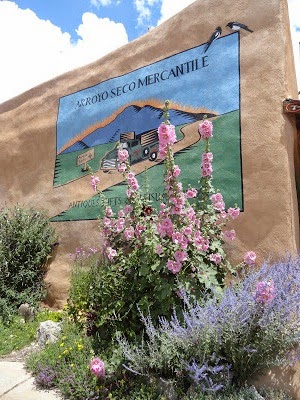
And one of our favourite stops in the area was Arroyo Seco, a village located just east of Taos.  We loved its tiny galleries, the mercantile and Taos Cow ice cream shop.  

Where to Stay:  
We were happy with all the places we stayed on this trip, but if we had to choose a favourite, it would be Casa Gallina, an enchanting bed and breakfast just outside of Taos.  It was close enough to town that we could drive there in a few minutes, but in every other way it felt as if we were in our own world.  Our balcony had chairs and a hammock, and another covered sitting area near our front door featured a second hammock.  Our room was beautifully decorated with work made by local artists, and the New Mexico evenings were cool enough that we could open the windows for a lovely cross-draft.  Our host, Richard, was friendly and very knowledgeable about the area, helping us get all the reservations we needed and pointing us in the direction of several sites that we might otherwise have missed.  We prepared our own breakfasts with freshly-laid eggs and produce from the garden, and whatever else we chose to pick up at Cid’s, the local grocery store.

Where to Eat:  El Meze is a tiny restaurant located just north of downtown Taos, and is superlative in both food and service.  At our request, the waiter took us through each of the dishes and gave his recommendations.  The seasonal starter of Spanish-cured ham, Manchego cheese and white nectarines was breathtaking, and the rest of the meal (fresh pasta with vegetables, almond semifreddo) was equally good.  The backyard view over the Sagre de Cristo mountains was gorgeous.  And when one of us accidentally left our VISA card there the owner came back the next morning to retrieve it for me us.

We also had a terrific meal at The Love Apple, an even smaller restaurant that serves organic and locally-grown food.  Not being overly hungry that night, I ordered a simple salad, and it was as good as salad can be when prepared with the freshest and most delicious ingredients.


Thursday's Child: Atacama Salt Flats, Chile

Thursday, June 28, 2012

"Near Antofagasta
the whole
saline plain
resounds:
it is a
broken
voice,
a song filled
with sorrow."

- from "Ode to Salt", Pablo Neruda


This month, I've been writing about some of the spectacular places we've seen, and I'll end where I began – in Chile.

The Atacama desert in the north of Chile is home to a number of salt plains, one of which is the Chaxa Lagoon.  Craggy mounds of hardened salt thrust up from the earth for miles and miles, extending to the border of the distant mountains.


These salt crystals were left behind after the evaporation of underground water. The scarcity of rainfall in the region, and the absence of a place for water to drain, have enhanced the strange beauty of these saline formations.


Thanks to the microscopic life in the lagoons, the flats are home to a wide variety of birds, some of which are endangered or vulnerable.  The area is particularly known for the flamingoes that live there, and has been designated a nature reserve.


But all these facts pale next to the otherworldly beauty of this stark, white terrain. And no one could describe it more beautifully than the brilliant Chilean poet, Pablo Neruda:


"Then in its caverns
the gem salt, mountain
of a buried light,
transparent cathedral,
crystal of the sea, oblivion
of the waves."
- from "Ode to Salt", Pablo Neruda